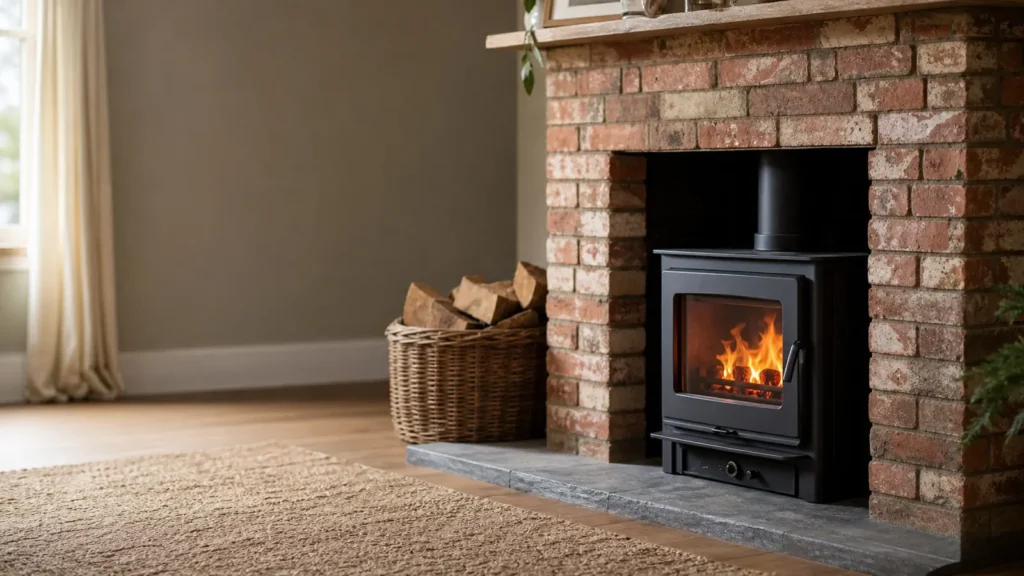
An insert is a wood stove built to sit inside an existing masonry fireplace. It turns an open fireplace, which sends much of its heat up the chimney, into a closed heater, typically an EPA-certified wood-burning insert. The two questions are whether it fits, and what chimney liner it needs.
On this page
1. Measure the fireplace
Measure the front opening width and height, the rear width, and the depth from the opening to the back wall. Insert manuals publish minimum fireplace dimensions for each model; compare yours against them before anything else.
2. Read the insert’s spec sheet
Example, Osburn 1700-I insert (per the installation and operation manual, accessed 2026-10-12) (manual):
| Spec | Osburn 1700-I |
|---|---|
| Overall firebox volume | 1.86 ft³ |
| EPA loading volume | 1.44 ft³ |
| Heating area (maker) | 500–1,800 ft² |
| Maximum heat output (dry cordwood) | 65,000 BTU/h |
| Average efficiency (HHV / LHV) | 68% / 73% |
| Flue outlet / connector | 6 in |
| Chimney liner type | ULC S635, CAN/ULC-S640, UL 1777 |
| Minimum liner height | 12 ft |
Size the insert the same way as a freestanding stove: by your home’s heat need, the loading volume and the output range. See what size wood stove do I need.
3. Plan the liner
Inserts vent through a liner that runs up inside the masonry chimney. The Osburn 1700-I manual calls for a liner listed to UL 1777 (in the U.S.) and a minimum liner height of 12 ft (manual). Your insert’s manual is the primary authority for liner size and type, alongside NFPA 211 and any stricter requirements from your local code official.
4. Check the hearth and surround
Insert manuals specify floor protection in front of the opening and clearances to combustible mantels and trim. Measure your hearth extension and mantel height against them.
5. Get the chimney inspected
Before installing, have the masonry chimney inspected and cleaned. Get any required permit, and have the finished installation inspected.
Insert vs freestanding stove in front of the fireplace
| Factor | Insert | Freestanding stove on the hearth |
|---|---|---|
| Where it sits | Inside the firebox opening | On the hearth, connected into the chimney |
| Heat delivery | Mostly from the front; blower helps | All sides radiate |
| Liner | Typically a full-length listed liner | Depends on the manual; often needs one too |
| Hearth | Must meet the insert’s floor-protection figures | Must meet the stove’s figures, often larger |
| Looks | Flush, tidy | Stove is visible |
Sizing an insert
The same rules as for stoves apply: match the tested overall heat output and loading volume to your heat need, not the heating-area claim. The Osburn 1700-I lists 1.86 ft³ firebox volume, 1.44 ft³ EPA loading volume and a maximum of 65,000 Btu/h, with 68% / 73% efficiency (HHV / LHV) (Osburn manual). Those are the same volumes the Osburn 1700 and Drolet Escape 1500 freestanding stoves list on their spec pages (checked October 12, 2026; see SBI firebox families). Use the stove sizing calculator for a first estimate of your heat need.
Blowers matter more on inserts
An insert is surrounded by masonry, so less heat radiates from its sides and back. Many inserts rely on a blower to move heat into the room; check whether the blower is standard or optional, its power needs, and whether there is an outlet near the fireplace.
Questions to ask an installer
- Is my chimney sound and the right height, and what liner diameter and listing does the insert require?
- Will the liner be insulated, and does the manual require it?
- Does my hearth extension meet the insert’s floor-protection figures?
- What are the mantel and side-trim clearances, and does my mantel meet them?
- Is a permit and inspection required here?
Sources
- Osburn 1700-I insert installation and operation manual: https://sbiweb.blob.core.windows.net/media/6998/45981_ia_2024-10-25.pdf