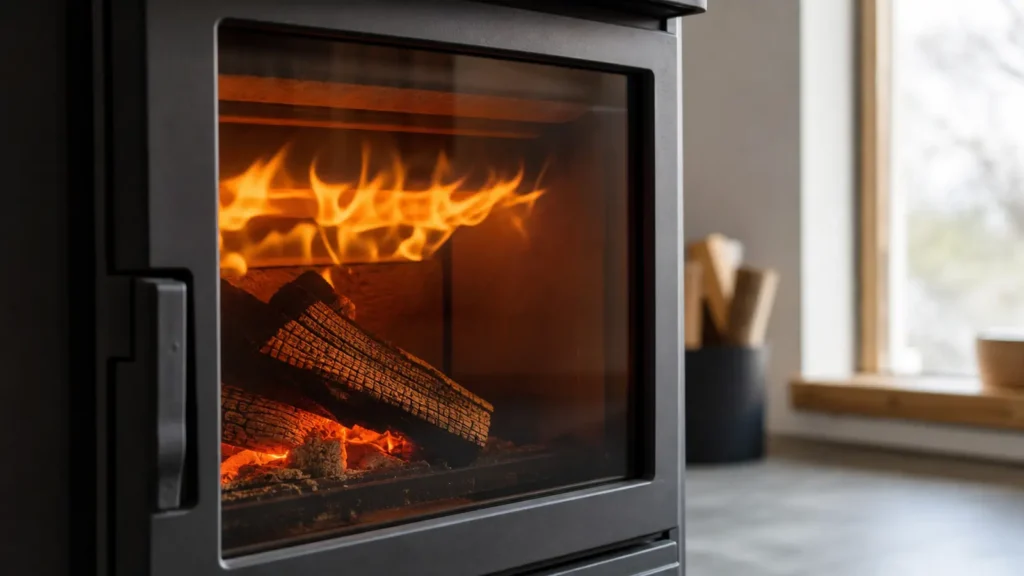
Modern EPA-certified stoves meet emission limits in one of two ways, or both. The difference affects how the stove burns, how much attention it needs and what you will replace over time.
On this page
At a glance
| Non-catalytic | Catalytic | Hybrid | |
|---|---|---|---|
| How it burns smoke | Secondary combustion: insulated firebox, baffle, preheated air jets | Smoke passes through a coated ceramic honeycomb | Both systems |
| Typical efficiency (HHV, EPA) | about 71% (range 60–80%) | about 78% (range 63–84%) | varies by model |
| Best at | Medium and high burns, visible flames | Long, low, even burns | Wide range of burn rates |
| Parts that wear | Baffle and some internal parts | Catalyst (replaceable) | Both |
| Operation | Simplest | Bypass damper for start-up and reloading | Model-specific |
Efficiency figures: EPA Frequent Questions.
Non-catalytic stoves
The EPA describes three features that make non-catalytic stoves burn cleanly: “firebox insulation, a large baffle to produce a longer, hotter gas flow path, and pre-heated combustion air introduced through small holes above the fuel” (EPA). According to the EPA, they make up about 80% of the market, tend to cost less and don’t need catalyst maintenance. The baffle and some internal parts need replacing from time to time.
Catalytic stoves
Smoke passes through a coated honeycomb where gases and particles ignite at lower temperatures. The EPA says the byproducts “generally burn at around 500 degrees, much lower than a non-catalytic stove, which needs a temperature of 1100 degrees,” which allows cleaner burning at low rates (EPA). Catalytic stoves have a bypass damper, opened for starting and reloading.
The catalyst wears out. EPA guidance says it “can last more than six seasons if the stove is used properly,” but over-firing, burning the wrong fuel or skipping maintenance can break it down “in as little as 2 years” (EPA).
Hybrid stoves
A hybrid has both a catalyst and secondary combustion, “so emissions are reduced from both low and high burns” (EPA). Expect a higher price and model-specific operation; read the manual before buying.
Which should you choose?
- You want simplicity and to watch the fire: non-catalytic.
- You want long overnight burns at low output: catalytic or hybrid.
- You burn a wide range of rates through the season: hybrid.
- Whatever you pick: burn only dry, seasoned wood. Wet wood and trash damage catalysts and foul every stove.
Sources
- EPA, Choosing the Right Wood-Burning Stove: https://www.epa.gov/burnwise/choosing-right-wood-burning-stove
- EPA, Frequent Questions about Wood-Burning Appliances: https://www.epa.gov/burnwise/frequent-questions-about-wood-burning-appliances