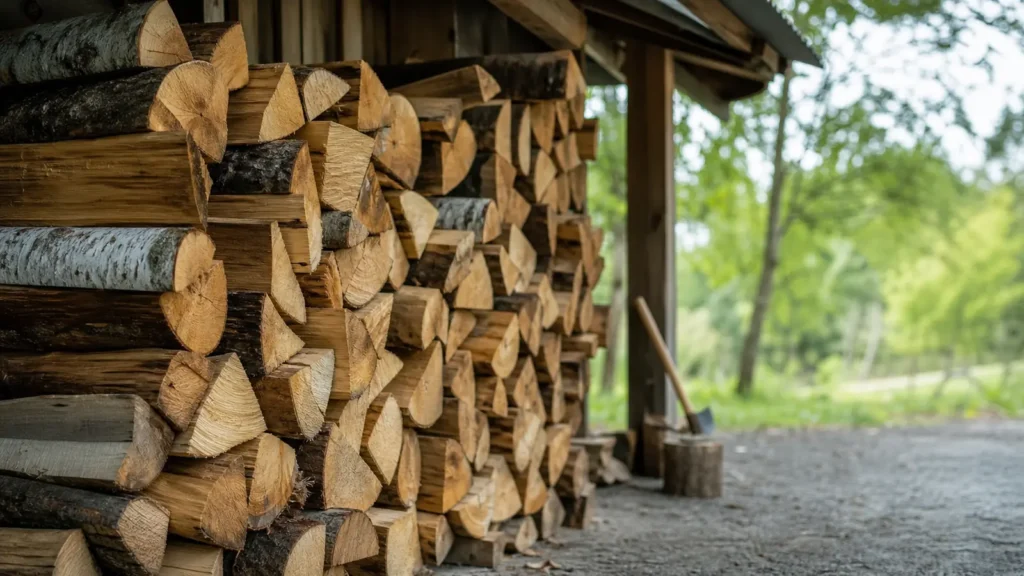
Dense hardwoods hold far more heat per cord than light woods. A cord of white oak carries nearly twice the heat of a cord of cottonwood, so the price per cord only tells half the story.
Heat per cord (air-dried)
Figures are million BTU per full cord (128 ft³ stacked) from Utah State University Extension’s firewood table (USU), which matches the University of Nebraska’s NebGuide (UNL).
| Species | Million BTU per cord | Dry weight (lb/cord) |
|---|---|---|
| Osage orange | 32.9 | 4,728 |
| Oak, white | 29.1 | 4,200 |
| Hickory, shagbark | 27.5 | 3,952 |
| Apple | 27.0 | 3,888 |
| Oak, bur | 26.2 | 3,768 |
| Maple (“other”, hard) | 25.5 | 3,680 |
| Oak, red | 24.6 | 3,528 |
| Ash, white | 24.2 | 3,472 |
| Elm, American | 20.0 | 2,872 |
| Ash, green | 20.0 | 2,880 |
| Douglas-fir | 20.7 | 2,970 |
| Maple, silver | 19.0 | 2,752 |
| Pine, ponderosa | 16.2 | 2,336 |
| Cottonwood | 15.8 | 2,272 |
| Pine, eastern white | 15.6 | 2,250 |
Values are for air-dried wood. Green wood delivers much less usable heat because energy goes into boiling off water.
Cost per million BTU
To compare offers, divide the price by the heat:
Cost per million BTU = price per cord ÷ million BTU per cord
Example: $300 for a cord of red oak (24.6) is about $12.20 per million BTU. $250 for a cord of cottonwood (15.8) is about $15.80. The cheaper cord costs more per unit of heat.
Two cautions: – Check the volume. A full cord is 128 ft³ stacked (4 × 4 × 8 ft). A “face cord” or “rick” is usually a fraction of that and varies by seller. – Your stove’s efficiency decides how much of that heat reaches the room. A 72% (HHV) stove delivers roughly 72% of it.
Sources
- Utah State University Extension, Wood Heating: https://extension.usu.edu/forestry/resources/forest-products/wood-heating
- University of Nebraska–Lincoln, G88-881 Heating With Wood: https://digitalcommons.unl.edu/cgi/viewcontent.cgi?article=1858&context=extensionhist