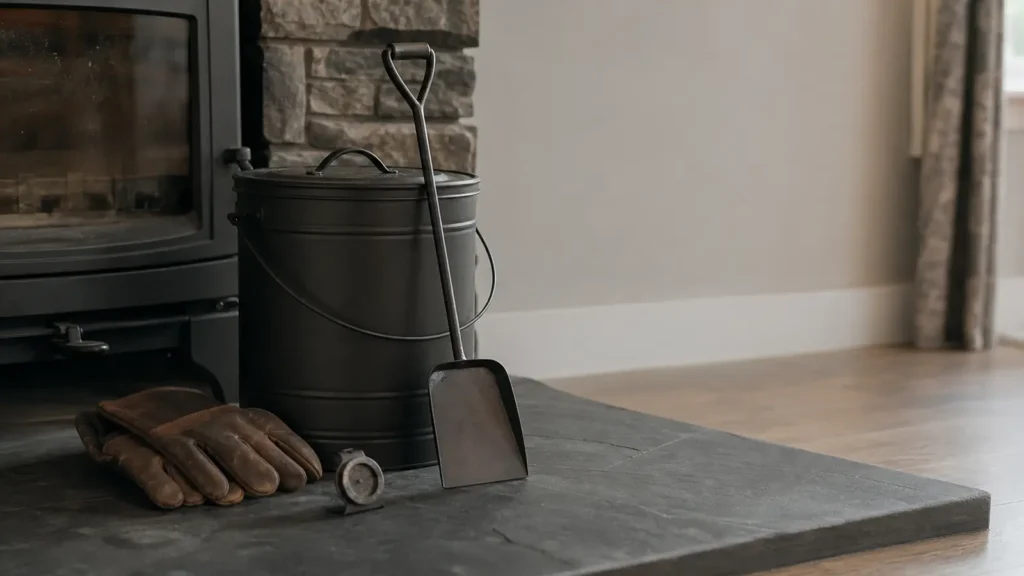
Most accessories are optional, but a few make burning safer and cleaner. Here is what each does and what to check before buying. We describe features from manufacturer and EPA information; we haven’t tested these products.
On this page
- 1. Wood moisture meter
- 2. Stove or flue thermometer
- 3. Smoke and carbon monoxide alarms
- 4. Ash tools and a metal ash container
- 5. Heat-resistant gloves
- 6. Blower or stove-top fan
- 7. A chimney inspection and cleaning plan
- 8. A fire extinguisher
- What not to buy
- Accessories that depend on your stove
- Quick checklist
- Ash safety in more detail
- FAQ
- Sources
1. Wood moisture meter
A very useful accessory. The EPA says wood burns best below 20% moisture and recommends testing with a moisture meter; its flyer puts basic meters at about $15–$40 (EPA flyer). Look for a pin-type meter with a wood setting, and test a freshly split face. See how to season firewood.
2. Stove or flue thermometer
A surface thermometer on the stovepipe or stove top shows whether you’re burning too cool (smoky, creosote-forming) or too hot (over-firing). Your stove’s manual may say where to mount one and what range to aim for; follow it rather than generic charts.
3. Smoke and carbon monoxide alarms
Any home with a wood stove should have working smoke alarms and CO alarms. Follow the alarm maker’s placement instructions and your local code.
4. Ash tools and a metal ash container
A metal container with a tight lid, kept outdoors away from the house and anything that burns, is the safe way to store ashes, which can stay hot for days.
5. Heat-resistant gloves
Long cuffs protect forearms when loading. Check the stated heat rating.
6. Blower or stove-top fan
Some stoves have an optional factory blower; the Drolet Escape stoves list a blower as optional (Drolet). A factory blower is designed and listed for that stove. Heat-powered stove-top fans are a separate add-on; check the maker’s temperature limits.
7. A chimney inspection and cleaning plan
Not a gadget, but the most important thing to budget for. NFPA 211 calls for chimneys, fireplaces and vents to be inspected at least once a year and cleaned as needed; the NFPA’s heating safety guidance repeats this for homeowners (NFPA). A certified chimney sweep can tell you how fast creosote builds up with your stove, wood and habits.
8. A fire extinguisher
Keep a multipurpose extinguisher where you can reach it without walking past the stove, and know how to use it. Follow the extinguisher maker’s instructions for checks and replacement.
What not to buy
- Unlisted pipe dampers, heat reclaimers or “heat exchanger” pipe sections that the stove manual doesn’t allow. They can cool the flue, add creosote or change clearances. Check the manual’s venting section first.
- Chemical chimney cleaners as a replacement for sweeping. They are not a substitute for inspection and mechanical cleaning.
- Grates or log racks inside a modern stove unless the manual calls for them. Many EPA-certified stoves are designed to burn on the firebrick floor.
Accessories that depend on your stove
Some items are model-specific: replacement gaskets, door glass, firebrick, baffle boards and, on catalytic stoves, the catalyst itself. Order these by your stove’s exact model number from the maker’s parts list, not by a generic size, and replace them as the manual describes. A worn door gasket lets in extra air, which makes the stove harder to turn down and can lead to over-firing.
Quick checklist
| Accessory | Why | What to check |
|---|---|---|
| Moisture meter | Confirms wood is under 20% | Pin type, wood setting |
| Stove or flue thermometer | Shows too cool or too hot | Mounting spot from the manual |
| Smoke and CO alarms | Life safety | Placement per maker and code |
| Metal ash can with lid | Hot ashes | Tight lid; store outdoors away from the house |
| Gloves | Burns when loading | Heat rating, long cuffs |
| Factory blower | Moves heat to the room | Listed for your model |
| Extinguisher | First response | Multipurpose type, reachable |
Ash safety in more detail
NFPA advises putting cooled ashes in a metal container with a lid, kept outside at least 10 feet from the home and other buildings (NFPA). Never use a plastic bucket, a cardboard box or a vacuum cleaner for ashes; embers can stay hot long after the fire looks out.
FAQ
Do I need a stove fan if I have a blower?
Usually not. A blower moves more air. A stove-top fan is an option for stoves without a blower, within its maker’s temperature limits.
Where should a CO alarm go?
Follow the alarm maker’s instructions and your local code. Common guidance is an alarm on every level and outside sleeping areas.
Sources
- EPA, Test Your Wood with a Moisture Meter (flyer): https://www.epa.gov/sites/default/files/2020-11/documents/moisturemeter_flyer_02112020_v1_d35_print_opt.pdf
- EPA, Best Wood-Burning Practices: https://www.epa.gov/burnwise/best-wood-burning-practices
- Drolet, Escape 1800: https://www.drolet.ca/us/en/wood-stoves/db03102/