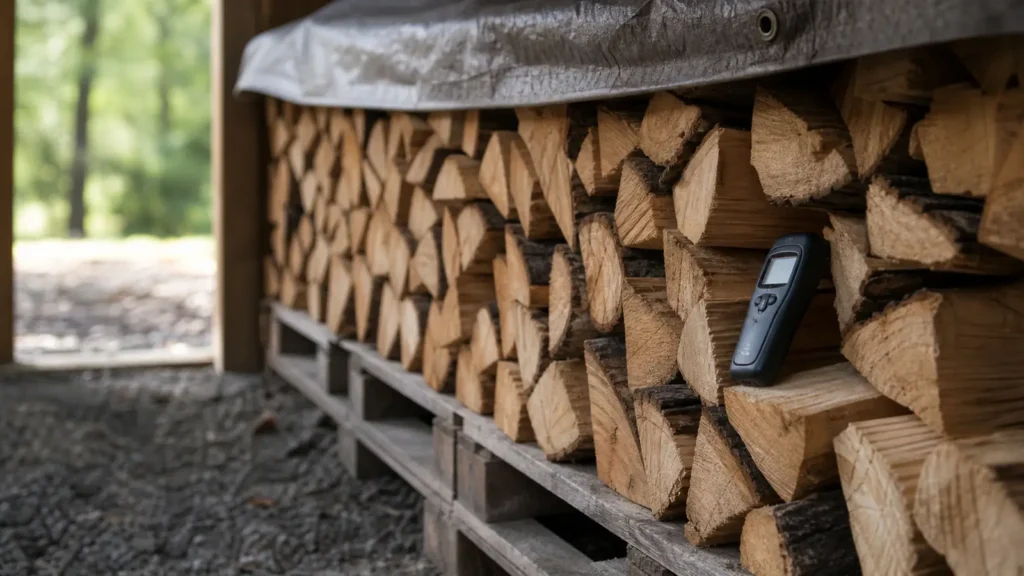
Dry wood is the single biggest factor in a clean, hot fire. Wet wood wastes heat boiling off water, makes more smoke, and builds creosote in the chimney.
The target: under 20%
The EPA says wood burns best at a moisture content below 20% and recommends checking with a wood moisture meter before burning (EPA). EPA’s flyer puts basic meters at about $15–$40 (EPA flyer).
How to season
Following EPA guidance (EPA):
- Split it. Pieces 6 inches across or smaller dry faster.
- Stack it off the ground, split side down.
- Cover only the top. Covering the sides traps moisture.
- Wait. At least 6 months for softwood and at least 12 months for hardwood.
How to test
- Take a piece from the middle of the stack.
- Split it and test the freshly split face, not the weathered outside.
- Push the meter’s pins in along the grain and read the result.
- If it reads 20% or less, it’s ready. If not, give it more time.
Signs of seasoned wood, per EPA: it’s darker, weighs less, and sounds hollow when knocked against another piece (EPA). A meter is more reliable.
What not to burn
Never burn trash, painted or treated wood, or wet wood. They pollute, damage catalysts and foul chimneys.
Sources
- EPA, Best Wood-Burning Practices: https://www.epa.gov/burnwise/best-wood-burning-practices
- EPA, Energy Efficiency and Your Wood-Burning Appliance: https://www.epa.gov/burnwise/energy-efficiency-and-your-wood-burning-appliance
- EPA, Test Your Wood with a Moisture Meter (flyer): https://www.epa.gov/sites/default/files/2020-11/documents/moisturemeter_flyer_02112020_v1_d35_print_opt.pdf