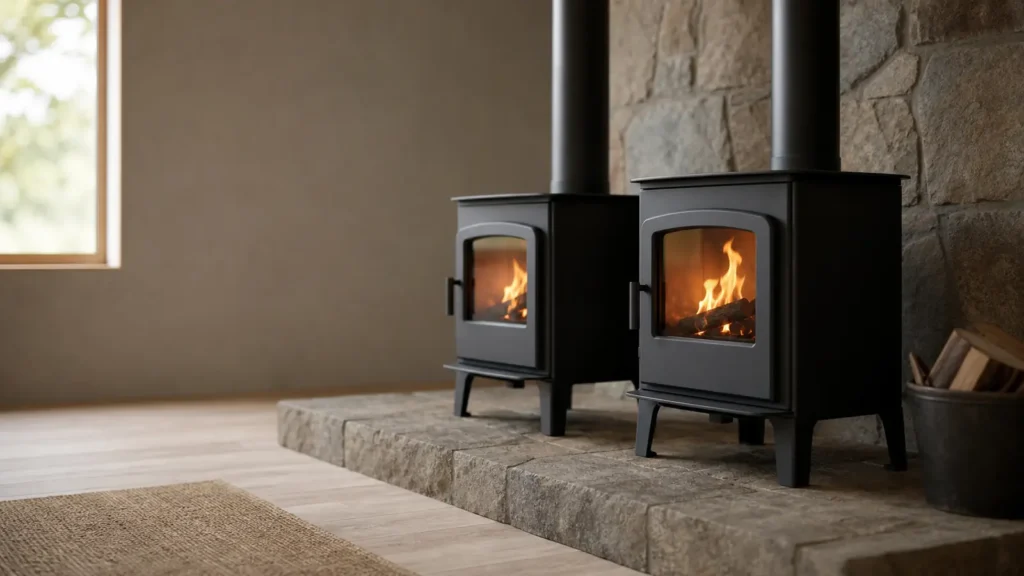
The Escape 1500 and Escape 1800 are two non-catalytic steel stoves from Drolet. Drolet now lists the Escape 1500 as discontinued, so you are most likely to meet it as remaining stock or a used stove. Every figure below comes from Drolet’s U.S. spec pages (1500, 1800).
On this page
Side by side
| Spec | Escape 1500 | Escape 1800 |
|---|---|---|
| Status | Discontinued | Current |
| Heating area (maker) | 500–1,800 ft² | 500–2,100 ft² |
| Overall firebox volume | 1.86 ft³ | 2.4 ft³ |
| EPA loading volume | 1.44 ft³ | 1.95 ft³ |
| Firebox W × H × D | 19 5/8 × 11 7/8 × 13 1/2 in | 21 × 12 × 16 1/2 in |
| Maximum log length | 18 in | 20 in |
| Maximum burn time | 7 h | 8 h |
| Maximum heat output (dry cordwood) | 65,000 BTU/h | 75,000 BTU/h |
| Overall heat output range | 9,800–52,200 BTU/h | 14,200–44,500 BTU/h |
| Average efficiency (HHV / LHV) | 68% / 73% | 72% / 77% |
| Particulate emissions | 2.4 g/h | 2.3 g/h |
| Average CO | 103 g/h | 69 g/h |
| Flue / chimney | 6 in, UL 103 HT, min. 12 ft | 6 in, UL 103 HT, min. 12 ft |
| Combustion | Non-catalytic | Non-catalytic |
| Mobile home / alcove approved | Yes (mobile home with fresh-air intake) / Yes | Yes / Yes |
What the differences mean
- Load size. The 1800’s EPA loading volume is about 35% larger (1.95 vs 1.44 ft³) and takes logs 2 inches longer. More wood per load is the main reason for its longer rated burn time.
- Low-end output. The 1500’s measured minimum output is lower (9,800 vs 14,200 BTU/h), which can suit a smaller or well-insulated space in mild weather.
- Efficiency and CO. The 1800 is rated higher on both efficiency bases and lower on CO.
- Availability. With the 1500 discontinued, check parts availability and warranty terms with a dealer before buying one.
Reading the numbers side by side
- Loading volume: 1.95 ÷ 1.44 ≈ 1.35, so the 1800 holds about 35% more wood per load. That’s the main reason for its longer rated burn time (8 h vs 7 h).
- Turn-down: the 1500’s lowest measured output (9,800 Btu/h) is about 31% lower than the 1800’s (14,200 Btu/h). In a small or tight house, that helps in shoulder seasons.
- Peak output: the 1800’s maximum with dry cordwood is 75,000 Btu/h vs 65,000; its overall measured range tops out lower (44,500 vs 52,200 Btu/h), because the two figures come from different measurements. Compare like with like.
- Efficiency and CO: the 1800 is rated 72% / 77% (HHV / LHV) against 68% / 73%, and 69 g/h CO against 103 g/h.
Matching each to a heat need
Use the stove sizing calculator to estimate your design-day need. As a rough guide from the tested ranges: if your central estimate sits in the low 20,000s Btu/h or below, the 1500’s lower minimum is an advantage; if it’s in the high 30,000s to 40,000s and you want fewer reloads, the 1800’s bigger firebox fits better. Both are estimates; a heat-loss calculation is better.
If you find a 1500 for sale
Because the Escape 1500 is discontinued, check three things before buying one: whether the dealer has it new in box with a full warranty, whether parts (baffle, gaskets, glass) are still listed by Drolet, and whether the certification label matches the manual you’ll install from. Osburn’s 1700 publishes the same firebox figures and is current; the same-firebox finder shows the match. Install each only by its own manual.
Clearances
The Escape 1500’s U.S. clearances are listed as 13 in to the back wall with single-wall pipe (6 in with double-wall), 10 in to a side wall and 84 in from the base to the ceiling (Drolet). Drolet notes that “the information given on the certification label affixed to the appliance always overrides” published figures. Always confirm clearances for both the 1500 and 1800 in their owner’s manuals and on the certification labels before installation.
Which home each fits
- Escape 1500: smaller or well-insulated homes, cabins, or supplemental heat, if you can find one with dealer support.
- Escape 1800: larger spaces, colder climates, or anyone wanting longer burns between loads.
Size to your home’s heat loss, not just the square-footage range. See what size wood stove do I need.
Sources
- Drolet, Escape 1500 (DB03135): https://www.drolet.ca/us/en/wood-stoves/db03135/
- Drolet, Escape 1800 (DB03102): https://www.drolet.ca/us/en/wood-stoves/db03102/
- Drolet, Escape 1800 owner’s manual: https://www.drolet.ca/file/46240_IA_2024-02-29.pdf