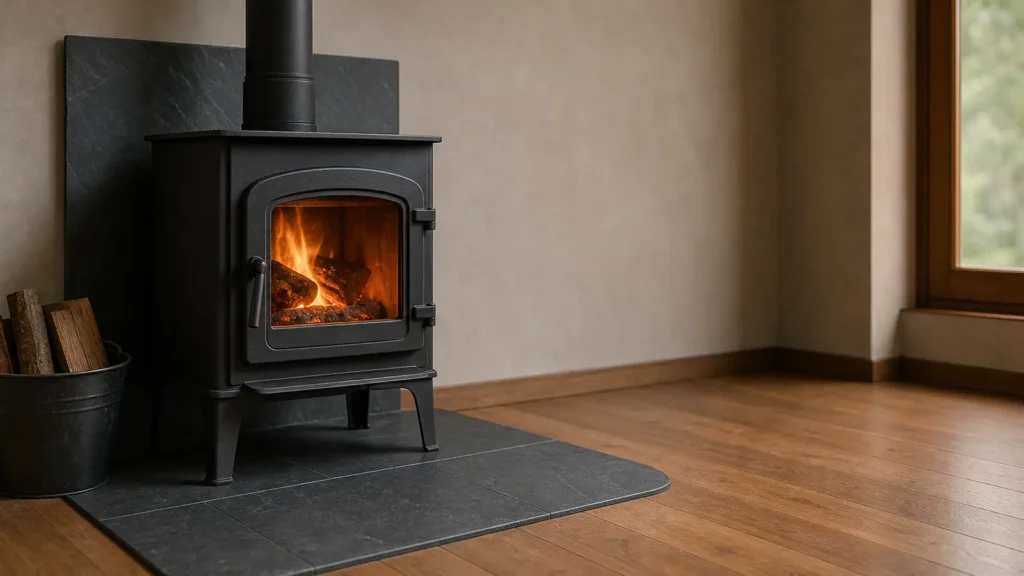
A hearth pad (floor protector) protects a combustible floor from heat under the stove and from embers that fall out when you load or clean it. What you need depends first on whether the stove is listed.
Listed stoves: the manual decides
Maine’s NFPA-based installation standards state that listed stoves “shall be placed on floors in accordance with the requirements of the listing and conditions of approval” (Maine Forest Service). The manual specifies how far the protection must extend in front of the door and to the sides and back, and sometimes a thermal rating (R-value) for the pad. Some listed stoves need only ember protection; others need an insulated pad.
Unlisted stoves: NFPA-based defaults
For stoves without a listing, where local code allows them, the same NFPA‑based standards set floor protection by leg height (Maine Forest Service):
| Stove leg length | Floor protection |
|---|---|
| Less than 2 in | Fire-resistant floor |
| 2–6 in | 4 in of hollow masonry laid for air circulation, covered with 24-gauge sheet metal |
| Over 6 in | 2 in thick masonry over 24-gauge sheet metal |
In this Maine NFPA‑based standard, the floor protection “shall extend not less than 18 in. (457 mm) beyond the appliance on all sides.” Always confirm dimensions against the current edition of NFPA 211 and your local code.”
Practical checks
- Find the floor-protection section and diagram in your stove’s manual.
- Measure from the right reference point (often the door opening for the front extension).
- If the manual calls for an R-value, check the pad or materials you plan to use meet it.
- Don’t place a stove on carpet or a combustible floor without the specified protection.
- Get any required permit and an inspection.
Sources
- Maine Forest Service, Recommended Standards for the Installation of Woodburning Stoves (NFPA-based): https://www.maine.gov/dacf/mfs/projects/woodheatmaine/downloads/woodstove_installation.pdf