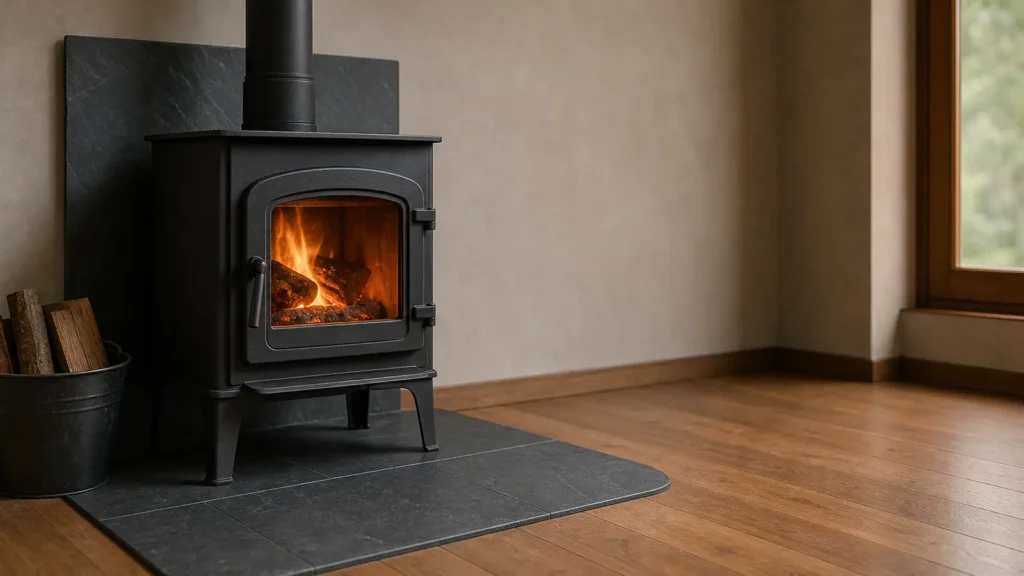
A hearth pad (floor protector) protects a combustible floor from heat under the stove and from embers that fall out when you load or clean it. What you need depends first on whether the stove is listed.
On this page
Listed stoves: the manual decides
Maine’s NFPA-based installation standards state that listed stoves “shall be placed on floors in accordance with the requirements of the listing and conditions of approval” (Maine Forest Service). The manual specifies how far the protection must extend in front of the door and to the sides and back, and sometimes a thermal rating (R-value) for the pad. Some listed stoves need only ember protection; others need an insulated pad.
Unlisted stoves: NFPA-based defaults
For stoves without a listing, where local code allows them, the same NFPA-based standards set floor protection by leg height (Maine Forest Service):
| Stove leg length | Floor protection |
|---|---|
| Less than 2 in | Fire-resistant floor |
| 2–6 in | 4 in of hollow masonry laid for air circulation, covered with 24-gauge sheet metal |
| Over 6 in | 2 in thick masonry over 24-gauge sheet metal |
In this Maine NFPA-based standard, the floor protection “shall extend not less than 18 in. (457 mm) beyond the appliance on all sides.” Always confirm dimensions against the current edition of NFPA 211 and your local code.
Practical checks
- Find the floor-protection section and diagram in your stove’s manual.
- Measure from the right reference point (often the door opening for the front extension).
- If the manual calls for an R-value, check that the pad or materials you plan to use meet it.
- Don’t place a stove on carpet or a combustible floor without the specified protection.
- Get any required permit and an inspection.
Ember protection vs thermal protection
Manuals use two kinds of floor protection, and the difference matters when you buy a pad:
- Ember protection is a noncombustible surface (for example sheet metal, tile or stone on a noncombustible backer) that catches sparks and falling coals. Some listed stoves with built-in bottom heat shields need only this.
- Thermal protection also insulates the floor from radiant heat under the stove. When a manual requires it, it usually gives a minimum thermal resistance as an R-value or a k-factor and thickness.
If the manual gives a k-factor, the pad maker should publish an R-value for its product. A thicker pad, or a different material, may be needed to meet the number. When the manual and the pad label don’t use the same units, ask the stove maker’s technical support before you buy.
Typical extensions to look for in the manual
Manuals give the pad’s required extension beyond the stove on each side and in front of the loading door, and they often differ between U.S. and Canadian installations. In Canada, CSA B365 applies; in the U.S., NFPA 211 and the listing apply. The figure that matters is the one printed for your country and your configuration. Measure the front extension from the door opening (or the point the manual shows), not from the front legs.
Corners, alcoves and raised hearths
- Corner installs often need a pad shaped to the corner clearances, and the extension in front of the door still applies.
- Alcoves have their own approval and minimum dimensions. Only install in an alcove if the manual lists alcove installation.
- Existing masonry hearths may already be noncombustible, but check what’s underneath: a hearth over a wood subfloor may still need the stove’s specified protection.
What a hearth pad doesn’t do
A hearth pad protects the floor. It doesn’t reduce wall clearances (that takes listed wall protection, set up as the manual or NFPA 211 describes) and it doesn’t replace a correctly installed chimney. Check your wall distances with the clearance checker and the clearances guide.
FAQ
Can I put a wood stove on ceramic tile?
Tile over a combustible subfloor may give ember protection but not thermal protection. Compare with your manual’s requirement.
Can a pad be bigger than required?
Yes. A larger pad catches more embers and is common practice. It must at least meet the manual’s minimum on every side.
Sources
- Maine Forest Service, Recommended Standards for the Installation of Woodburning Stoves (NFPA-based): https://www.maine.gov/dacf/mfs/projects/woodheatmaine/downloads/woodstove_installation.pdf