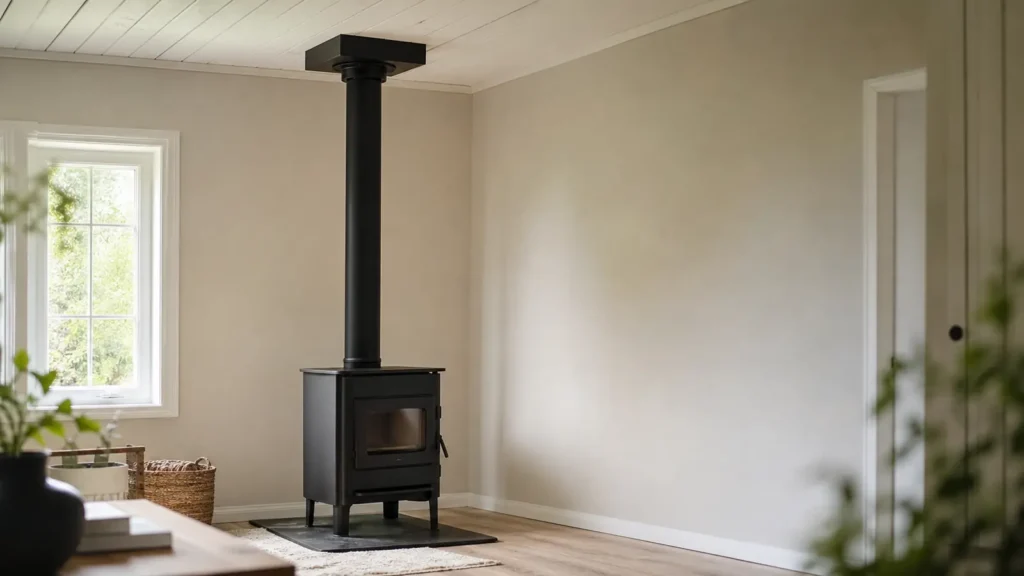
A wood stove venting system has two parts: the connector (stovepipe) that runs from the stove to the ceiling or wall, and the chimney that carries smoke out of the house. They are different products with different listings and rules.
On this page
The connector: single-wall or double-wall stovepipe
- Single-wall pipe needs the most room. Building officials often reference NFPA 211’s 18 inches to combustibles for single-wall connector pipe, reducible only with approved protection (Maine State Fire Marshal / NFPA-based standards).
- Double-wall (reduced-clearance) pipe is listed for smaller clearances, which are printed on the product’s listing.
- Pipe type can change the stove’s clearances too. The Drolet Escape 1500’s U.S. rear clearance is 13 in with single-wall pipe but 6 in with double-wall (Drolet).
Stovepipe is a connector only. It stops where the system passes through a ceiling, wall or roof, where a listed chimney takes over (typically via a listed ceiling support box or wall thimble).
The chimney
- Factory-built (Class A) chimney: insulated metal chimney listed for solid fuel. Drolet’s Escape stoves call for chimney listed to UL 103 HT (2100 °F) in the U.S. (Drolet). The chimney’s own listing sets its clearances and support requirements.
- Masonry chimney: must be sound and correctly sized; often needs a liner.
- Liner: a metal liner inside a masonry chimney. Inserts typically need one. The Osburn 1700-I insert calls for a liner listed to UL 1777 with a minimum height of 12 ft (manual).
Size and height
Match the flue diameter in the manual: the Escape stoves have a 6 in flue outlet and call for a 6 in chimney at least 12 ft tall (Drolet). Don’t reduce pipe size below the stove’s outlet unless the manual allows it.
How the parts fit together
| Part | Job | Who lists it |
|---|---|---|
| Stove collar (flue outlet) | Where the connector attaches | Stove maker’s manual |
| Connector (stovepipe) | Stove to ceiling or wall, inside the room | Pipe maker; NFPA 211 for unlisted single-wall |
| Ceiling support box or wall thimble | Carries the system through combustibles | Chimney maker’s listed system |
| Chimney (Class A or masonry with liner) | Takes smoke outside | Chimney or liner maker’s listing |
| Cap and spark arrestor | Keeps rain and animals out | Chimney maker’s listed parts |
Draft basics
A chimney works because hot flue gas is lighter than outside air. Height, flue size, how warm the chimney stays and how many bends there are all affect draft. That’s why manuals specify a minimum chimney height (12 ft for the Drolet Escape stoves) and limit elbows and horizontal runs. An exterior chimney on a cold wall can draft poorly at start-up; an interior chimney stays warmer. A chimney that’s too short or too large for the stove can spill smoke when you open the door.
Height above the roof
The common rule for chimney termination is often called the 3-2-10 rule: the chimney must extend at least 3 feet above where it passes through the roof and at least 2 feet higher than any part of the building within 10 feet horizontally. It appears in NFPA 211 and building codes; your chimney’s listing and your local code govern. Check the current edition and local amendments.
Inspection and creosote
Creosote forms when smoke cools and condenses in the connector and chimney. Wet wood and slow, smoldering fires make more of it. NFPA 211 calls for chimneys and vents to be inspected at least once a year and cleaned as needed (NFPA). Burn dry wood (under 20% moisture per the EPA) and avoid long smoldering burns to slow buildup (EPA).
Common mistakes
- Running single-wall pipe through a ceiling or wall. It’s a connector only.
- Mixing brands of listed chimney parts.
- Reducing pipe diameter below the stove’s outlet without the manual’s approval.
- Long horizontal runs without the slope and support the manual requires.
- Skipping the chimney cap.
Before you buy parts
- Read the stove manual’s venting section.
- Use one manufacturer’s listed system for the chimney, and follow its installation guide.
- Get a permit if required, and have the system inspected.
Sources
- Drolet, Escape 1500: https://www.drolet.ca/us/en/wood-stoves/db03135/
- Drolet, Escape 1800: https://www.drolet.ca/us/en/wood-stoves/db03102/
- Osburn 1700-I insert manual: https://sbiweb.blob.core.windows.net/media/6998/45981_ia_2024-10-25.pdf
- Maine Forest Service, Recommended Standards for the Installation of Woodburning Stoves (NFPA-based): https://www.maine.gov/dacf/mfs/projects/woodheatmaine/downloads/woodstove_installation.pdf