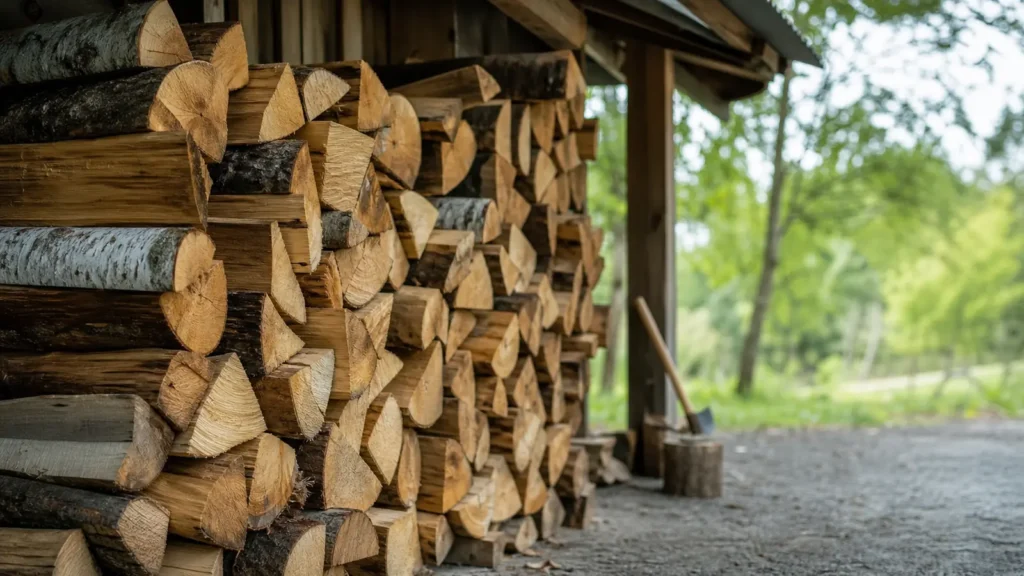
Dense hardwoods hold far more heat per cord than light woods. A cord of white oak carries nearly twice the heat of a cord of cottonwood, so the price per cord only tells half the story.
On this page
Heat per cord (air-dried)
Figures are million BTU per full cord (128 ft³ stacked) from Utah State University Extension’s firewood table (USU), which matches the University of Nebraska’s NebGuide (UNL).
| Species | Million BTU per cord | Dry weight (lb/cord) |
|---|---|---|
| Osage orange | 32.9 | 4,728 |
| Oak, white | 29.1 | 4,200 |
| Hickory, shagbark | 27.5 | 3,952 |
| Apple | 27.0 | 3,888 |
| Oak, bur | 26.2 | 3,768 |
| Maple (“other”, hard) | 25.5 | 3,680 |
| Oak, red | 24.6 | 3,528 |
| Ash, white | 24.2 | 3,472 |
| Douglas-fir | 20.7 | 2,970 |
| Elm, American | 20.0 | 2,872 |
| Ash, green | 20.0 | 2,880 |
| Maple, silver | 19.0 | 2,752 |
| Pine, ponderosa | 16.2 | 2,336 |
| Cottonwood | 15.8 | 2,272 |
| Pine, eastern white | 15.6 | 2,250 |
Values are for air-dried wood. Green wood delivers much less usable heat because energy goes into boiling off water.
Cost per million BTU
To compare offers, divide the price by the heat:
Cost per million BTU = price per cord ÷ million BTU per cord
Example: $300 for a cord of red oak (24.6) is about $12.20 per million BTU. $250 for a cord of cottonwood (15.8) is about $15.82. The cheaper cord costs more per unit of heat.
Two cautions: – Check the volume. A full cord is 128 ft³ stacked (4 × 4 × 8 ft). A “face cord” or “rick” is usually a fraction of that and varies by seller. – Your stove’s efficiency decides how much of that heat reaches the room. A 72% (HHV) stove delivers roughly 72% of it.
Delivered heat: the efficiency step
Heat in the wood isn’t heat in the room. Multiply by your stove’s efficiency (HHV basis) to get delivered heat. The EPA puts typical non-catalytic stoves at about 71% and catalytic stoves at about 78% (HHV) (EPA).
| Species (air-dried) | Million Btu per cord | Delivered at 70% | Cords for 40 million Btu delivered |
|---|---|---|---|
| Oak, white | 29.1 | 20.4 | 2.0 |
| Oak, red | 24.6 | 17.2 | 2.3 |
| Douglas-fir | 20.7 | 14.5 | 2.8 |
| Pine, ponderosa | 16.2 | 11.3 | 3.5 |
| Cottonwood | 15.8 | 11.1 | 3.6 |
Calculated from the USU table above. 40 million Btu delivered is an example, not a typical home’s need.
Worked comparison with other fuels
Using EIA conversion factors (EIA) and example prices, the delivered cost per million Btu is:
| Fuel | Example price | Efficiency | Delivered $/million Btu |
|---|---|---|---|
| Red oak firewood | $300 per cord | 70% | $17.42 |
| Natural gas | $1.50 per therm | 95% | $15.79 |
| Propane | $2.50 per gallon | 90% | $30.37 |
| Heating oil | $4.00 per gallon | 85% | $33.98 |
| Electric resistance | $0.1831 per kWh | 100% | $53.66 |
| Heat pump | $0.1831 per kWh | COP 2.5 | $21.47 |
The electricity price is the U.S. average residential rate for July 2026 (EIA); the other prices are examples, so put in your own with the firewood cost calculator. Firewood’s cost also depends on labor: hauling, splitting and stacking your own wood changes the picture.
Softwoods aren’t “bad”
Lower heat per cord doesn’t make softwood unsafe or dirty. Dry softwood lights easily and burns hot and fast, which is useful for kindling, spring and fall fires and quick warm-ups. What causes creosote is wet wood and smoldering fires, not species. Price softwood by the heat it delivers, and season it properly.
FAQ
Is a “face cord” a third of a cord?
Only if the logs are 16 inches long (8 ft × 4 ft × 16 in = 42.7 ft³). Face cords of other log lengths are different fractions. Measure.
Why do different charts give different numbers?
Sources use different moisture assumptions and test methods. We use one table (USU, matching the University of Nebraska NebGuide) so species compare fairly.
Do these numbers apply to green wood?
No. The table assumes air-dried wood. Water in the wood has to be boiled off before it gives you heat, so wet wood delivers less of the listed value and makes more smoke and creosote. EPA’s Burn Wise guidance says wood burns best below 20 percent moisture and recommends seasoning softwood for at least 6 months and hardwood for at least 12 months. Check with a moisture meter on a freshly split face (EPA Burn Wise).
How do I measure what I bought?
Stack the wood tightly, with the pieces parallel and touching, then multiply width × height × length. A full cord is 128 cubic feet, for example 4 × 4 × 8 ft or 2 × 4 × 16 ft. NIST’s consumer fact sheet says firewood can only be sold by the cord or by fractions of a cord, and that terms such as “face cord,” “rack” or “truckload” have no legal meaning (NIST, Buying Firewood). Once you know the real volume, divide the price by the million Btu in that volume. For example, a hypothetical $300 full cord of white oak (29.1 million Btu) works out to about $10.31 per million Btu before stove efficiency. The same price for cottonwood (15.8) is about $18.99.
Sources
- Utah State University Extension, Wood Heating: https://extension.usu.edu/forestry/resources/forest-products/wood-heating
- University of Nebraska–Lincoln, G88-881 Heating With Wood: https://digitalcommons.unl.edu/cgi/viewcontent.cgi?article=1858&context=extensionhist